Follow on Twitter;
https://twitter.com/Londrileno
Showing posts with label winner. Show all posts

Wednesday, 11 June 2014

Player-by-player guide to the WC 2014 Spain squad

Yes, yes, the time is finally here. The World Cup kicks off on Thursday and they should hopefully have put out the last of the protest fires and got all the stadia mostly finished by then. To celebrate futebol coming home, then, here is a player-by-player guide to the Spain squad hoping to defend their crown and extend their historic streak:

Squad #        Name                  d.o.b.                 Club side             #caps   #goals                                        
     1          Iker Casillas       20/05/1981       Real Madrid            154       -

     San Iker has collected more international caps than the rest of the world put together since making his debut as a foetus in 2000. He won his third Champions League with Real Madrid this season despite binman Diego López being preferred by manager Carlo Ancelotti's eyebrow in La Liga. Despite an unbelievable number of international records under his belt already, Casillas may have to move on if he wants first team football next season. Has been Spain captain since 2008 and led the side to two European Championship victories and that World Cup trophy last time out in South Africa. Quite simply one of the best goalkeepers of all time.

interesting* fact: Iker Casillas has more caps than three entire other teams at the World Cup.
------------------------------------------------------------------------------------------------------------
    12        David de Gea     07/11/1990   Manchester United       1       -

     Although the 2013/14 season was an annus horribilis (make sure to spell that right) for Manchester United, de Gea has continued to improve in the self-styled BESTEST LEAGUE IN THE WORLD EVERR. No longer the pasty, string bean-vampire from when he first came to these shores, the young 'keeper seems to finally have gotten over his phobia of crosses. No doubt he will be a very good goalkeeper for Spain one day, but not before Casillas hangs up his gloves (or whatever 'keepers do when they retire) in 20 years or so.

interesting* fact: de Gea was once fined at Man Utd for keeping a vocal score during a particularly one-sided youth team match he was watching. "FOUR goals ah, ah, ah! FIVE goals ah, ah, ah! SIX..." etc etc
------------------------------------------------------------------------------------------------------------
    23         Pepe Reina       31/08/1982              Napoli                   31       -

     Pretty much in the squad as a mascot/official cheerleader. Usually acknowledged as the joker of the group, 'The Pepe Show' has become a fixture of any Spanish victory celebrations. This sees him get slightly bevvied up before introducing the players one by one, in his own inimitable fashion.

interesting* fact: Stanley Tucci is entirely a construct of Pepe Reina's twisted mind.
------------------------------------------------------------------------------------------------------------
     2           Raúl Albiol        04/09/1985              Napoli                   46       -

     Albiol forms part of the Spanish 'B' team that Rafa Benítez is dastardly putting together on the quiet at Napoli, possibly with a view to attacking the Spanish mainland from his Mediterranean base. The swarthy defender has shown himself able to grow a fine beard on occasion, but is not believed to be unleashing its full force upon an unsuspecting global audience in Brazil. Despite a chronic lack of pace, he helped gli Azzurri to victory in the Coppa Italia as well as a third-place finish in Serie A.


interesting* fact: Albiol also has one World Cup and two European Championship winners medals. No-one quite knows how or why.
------------------------------------------------------------------------------------------------------------
     3         Gerard Piqué      02/02/1987          Barcelona               60       4

     When not galavanting about with girlfriend Shakira, Piqué sometimes plays a bit of football for Barcelona. He acquired the improbable nickname Piquenbauer as a younger footballer but his previous aura of calmness seems to have been shattered over the past couple of seasons. Then again who wouldn't be put off by having to play with Javier Mascherano as a centre-back partner. Forms a solid partnership with Ramos on the international scene.

interesting* fact: While Shakira's hips don't lie, Piqué's knees do, hence why he wears his socks so high.
------------------------------------------------------------------------------------------------------------
     5             Juanfran          09/01/1985       Atlético Madrid        7      -

     Juanfran was one of the stand-out performers for Atlético Madrid in the best season the club's fans have ever seen, winning La Liga and only losing at the very last hurdle against cross-town enemies Real in the Champions League final. I'm going to stick my neck out and presume he'll be starting at right back for La Furia Roja, mainly because his name's easier for commentators to pronounce than Azpilicueta. Not really - that's no way to decide a starting XI. Otherwise no Ukrainians would ever get to play.


interesting* fact: If he'd been born a girl, Juanfran would have been called Franjuan.
------------------------------------------------------------------------------------------------------------
    15        Sergio Ramos    30/03/1986        Real Madrid          116     9

     Although he's gained a reputation as a dirty player, Ramos has really stepped forward for Real Madrid this season and has become a real team leader. This is best exemplified by the number of vital goals he's come up with this season - his late, late equalising goal to take the Champions League final to extra time was voted the Real Madrid goal of the season. Not as thuggish as his red cards record suggests, Ramos exemplifies a 'win-at-all-costs' mentality. He's also guaranteed to try another Panenka if any Spain games end up going to penalties.

interesting* fact: Ramos holds the record for the highest number of red cards in the history of Real Madrid, with 703.
------------------------------------------------------------------------------------------------------------
    18          Jordi Alba         21/03/1989          Barcelona              26       5

     The small left-back's style of play is integral to the way Spain like to play - flying down the left wing at any given opportunity, Alba constantly offers the overlap to his midfield munchkins. He's often seen as the furthest-forward Spanish player, which can sometimes take cameramen and even his own teammates by surprise. Consequently he's got a great goalscoring record for his position at international level.


interesting* fact: Although not an angry man by nature, he doesn't like you. Yes, you.
------------------------------------------------------------------------------------------------------------
    22    César Azpilicueta  28/08/1989            Chelsea                   6       -

     Bought from Marseille a couple of seasons back, Azpilicueta now operates as Chelsea left-back/right-back. Rumours that he's taken to shooting work experience kids with air rifles are, at time of writing, unconfirmed. Should be an interesting battle between Azpilicueta and a few others to be the regular Spain right-back over the coming years. Dani Carvajal was unlucky to miss the final squad cut in the end, and could provide good competition over the coming seasons along with Juanfran.


interesting* fact: His nickname at Chelsea is 'Dave', but only because John Terry can't spell his actual name. To be fair, John Terry can't spell full-stop, so it's not all that surprising.
------------------------------------------------------------------------------------------------------------
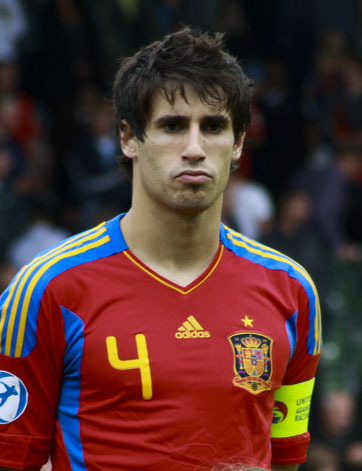
     4        Javi Martínez       02/09/1988      Bayern Munich         17     -

     Another successful season in Germany ended with Bayern Munich winning a second consecutive Bundesliga trophy. Martínez continued to alternate games between centre-mid, centre-back and the bench. A big bruising player, he sticks out like a sore thumb among all the diminutive Spanish passing gnomes around him when he does play for la Roja. Mostly he's a back-up player. Or back-up back-up due to his versatility.


interesting* fact: His forefathers were vikings who came from the north by way of Aberdeen, then Hull, before finally settling down in the north of Spain. They were aiming for Amsterdam but overshot.
------------------------------------------------------------------------------------------------------------
     6       Andrés Iniesta      11/05/1984          Barcelona               96    12

     Iniesta is the scorer of the most important goal in Spanish footballing history and still gets a positive reception from opposition fans when Barça play away games. He's deceptively good on the ball with a low centre of gravity and seems to float past defenders like the ghost he resembles. Links up well with fellow Barcelona man Xavi, but tends to play wider on the left internationally. By all accounts, a thoroughly nice bloke. Just needs to get out in the sun a bit more. Not too hard in Spain, you'd think.


interesting* fact: Iniesta is actually a Thunderbird. Once you know the strings are there you'll be able to spot them easily.
------------------------------------------------------------------------------------------------------------
     8                 Xavi               25/01/1980          Barcelona             132   13


     Quite simply a midfield metronome. He's not a fast player, doesn't shoot too often and is no better a dribbler than your average player - how did this guy make it as a footballer?! Quite simply the best in the world at passing to a teammate 5m away. Xavi was pivotal to the creation of the highly-successful but often eye-meltingly boring art of tiki-taka. Usually to be found in the centre circle directing the entire game despite looking half asleep.

interesting* fact: Xavi will always be able to spot if Sergio Ramos is about to miss a penalty before anyone else does.
------------------------------------------------------------------------------------------------------------
    10       Cesc Fàbregas   04/05/1987      Barcelona           89   13

     The former Arsenal, current Barcelona and possibly future Chelsea player is nominally a midfielder, but is more usually spotted for Spain deployed in the 'false nine' role. If it's two things this Spain team will be remembered for (apart from being the greatest of all time) it'll be the phrases tiki-taka and false bloody nine. Though his club are currently hawking him around Europe for EUR30m, for a makeshift striker/midfielder (strikefielder?) Cesc doesn't boast too many goals.

interesting* fact: Barcelona are only trying so hard to sell Cesc back to Arsenal so that they can then buy him back in another couple of years. They intend to do this at least two more times.
------------------------------------------------------------------------------------------------------------
   13        Juan Mata      28/04/1988   Manchester United     32      9

     Yet another tricksy, fun-sized Spanish midfielder. Despite the disadvantage of having a big ol' square head, Mata is actually very nippy. A good eye for a pass as well means it'll be interesting to see the battle between him, Rooney and Kagawa for the #10 role at Manchester United next season. Despite his attributes and undoubted quality, Mata's still not a starter for Spain.


interesting* fact: Mata's head is actually a giant Lego brick.
------------------------------------------------------------------------------------------------------------
    14        Xabi Alonso       25/11/1981         Real Madrid         110    15
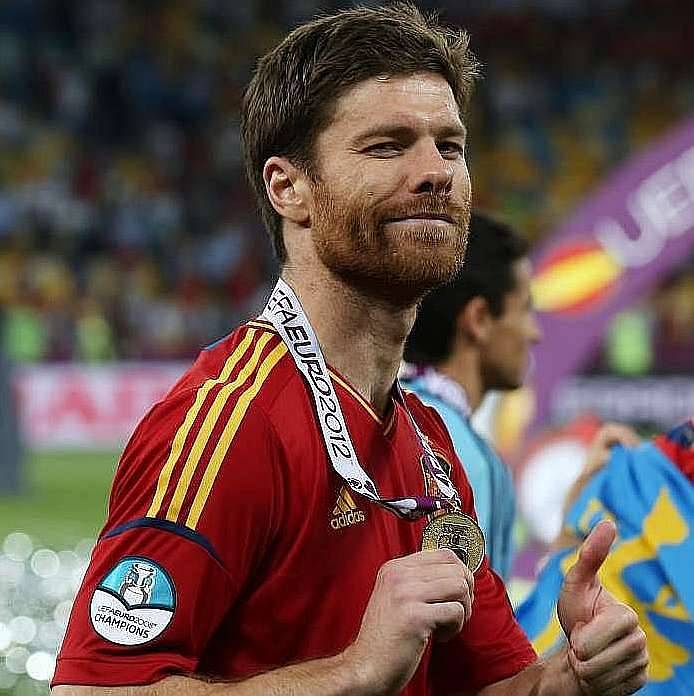
     Like Xavi, another player integral to keeping possession of the ball in the Spanish midfield. However, Xabi Alonso boasts a far greater range of passing than the Barcelona man, albeit with not as high a completion rate. Also likes the occasional speculative strike from 3 miles away from goal, just for shits and giggles. Showed class by not doing a John Terry at the Champions League final.


interesting* fact: It's not true that Xabi Alonso has brown hair but a red beard. He dyes them both, so in actual fact he was born with red hair and a brown beard.
------------------------------------------------------------------------------------------------------------
    16    Sergio Busquets  16/07/1988           Barcelona                65       -

     I'll be straight-up honest here; I don't like Busquets as a human being out there on the pitch and genuinely think he's overrated as a player. And he looks like a rat. And he is a rat. But then again he's a mainstay in the Spanish team and has been for years so maybe I just missed a memo or something. But he's still a rat. If you Google his name, the first suggested result that pops up is 'Sergio Busquets dive'. Says it all really.

interesting* fact: Sergio Busquets' nickname is Hyacinth.
------------------------------------------------------------------------------------------------------------
    17              Koke              08/01/1992       Atlético Madrid           8        -

     The new kid on the block of an extremely settled Spain squad, Koke is another one that enjoyed a fantastic 2013/14 with Atlético Madrid. A good spotter of a pass, his game has continued to improve and he ended the season with a highly-impressive 14 assists. Made the final cut for the World Cup squad thanks to injuries to Jesús Navas and Thiago Alcântara.


interesting* fact: Koke used to be a bit of a fatty. Since slimming down, he has been awarded the nickname 'Diet'.
------------------------------------------------------------------------------------------------------------
  20       Santi Cazorla      13/12/1984            Arsenal             63      10

     Quite possibly the smallest man in the world, Santi Cazorla has continued to grow as a footballer if not as a human man. A world-class dribbler, it defies belief how genuinely two-footed he is - he can strike the ball or spank a long-range pass equally as well with either foot. Still not good enough for a starting berth for his country though, for all that. Also boasts good straight-line speed thanks to the aerodynamics of his large hooter - Cazorla's face is essentially just a nose with eyes on the side instead of nostrils.

interesting* fact: Born to a poor family, Cazorla used to have to sleep in a cigarette packet until the age of 13, which stunted his growth somewhat.
------------------------------------------------------------------------------------------------------------
  21        David Silva         08/01/1986    Manchester City    80      20

     Like Cazorla but plays for a more successful club. Instead of an Easter Island nose, though, David Silva has a beauty spot like that Cindy Crawford. What isn't widely known is that it's removable and the midfield maestro sometimes wears it on the other side of his face. Other times he decides to forgo it completely. Such is the life of the fashion-conscious footballer. And a ruddy good footballer he is too. After another solid season controlling Man City's attacking play he could start on the right wing for Spain, cutting in onto his left foot.

interesting* fact: At an end-of-season beano once, Silva was disciplined after sticking his removable beauty spot to the middle of his forehead and making a racially insensitive joke.
------------------------------------------------------------------------------------------------------------
   7          David Villa       03/12/1981       Melbourne City        96     58

     The third of four players in the Atlético Madrid contingent, David Villa scored 13 goals in 36 Liga games this season, playing a large part in securing the historic championship. After the celebrations died down, he became the first (and so far only!) player to sign for New York City. However, seeing as they don't exist as a footballing entity until 2015, he was immediately loaned out to Melbourne City instead. Like all ageing footballers since time immemorial going across the pond for a final payday, Villa's heading there in order to 'build the sport' in America.


interesting* fact: In English, David Villa's name means David Villa.
------------------------------------------------------------------------------------------------------------
    9      Fernando Torres  20/03/1984            Chelsea              107     37

     You'd think that 30 would be an age by which people would've stopped calling you 'The Kid', especially if you had a voice as sonorously deep as Torres', but apparently not. Refound his scoring boots for Chelsea sporadically this season, but that work experience lad keeps hiding them again. Used to be the main man up top for club and country, but has slipped down the pecking order somewhat. Frankly, I'm surprised he's been picked ahead of Álvaro Negredo. The unfortunate City striker misses out at the very last moment for the second tournament in succession.

interesting* fact: The real reason Ashley Cole shot that kid was 'cos he kept playing silly beggars with Nando's boots. Cashley was just trying to help a mate and ended up getting vilified for it. Torres didn't even stand up for him and explain.
------------------------------------------------------------------------------------------------------------
    11             Pedro            28/06/1987          Barcelona              40      14

     As a younger player he went by the name Pedrito. Unlike Torres, however, he eventually realised when the time was right to move on, and dropped the diminutive. He's absolutely lightning-quick across the ground but doesn't exude skills. Then again it must be hard to do stepovers (that's 'lollipops', to Big Ron Atkinson fans) while your legs are whirling around like a Mexican cartoon mouse.


interesting* fact: Pedro has been clocked doing the 100m in 3.82secs. He was consequently fined as he was in a 30mph zone at the time.
------------------------------------------------------------------------------------------------------------
    19         Diego Costa      07/10/1988      Atlético Madrid           2       -

     Costa apparently chose to represent Spain because Big Phil Scolari didn't phone him up personally, even though the World Cup being held in the country of his birth should be incentive enough. It's not quite Yaya Touré levels of sheer idiocy, but not far off. I can foresee an uncomfortable reception for the big man, especially if the two countries end up facing off in the second round. After slathering horse placenta over his leg, Costa reckons he's now over his injury and raring to go.


interesting* fact: Costa is Spanish. A 100% bona fide Iberian bull.
------------------------------------------------------------------------------------------------------------


The main problem I can see with this Spain team is that they're going to look stupid wearing all red rather than their iconic dark blue shorts, thanks to Adidas screwing up following FIFA's pointless and daft explanation on kit regulations. Most positions are already taken in the Spain starting XI with only a couple in doubt. Truthfully, this is a very settled side apart from at right-back and up front. I reckon Torres may start the first game on Friday but after that Costa will make his World Cup bow, being given a little more time to recover from his hamstring injury. Meanwhile, I expect César Azpilicueta to start at right-back, no matter the difficulties it may cause some pundits;

                                                                          Casillas (c)

                                   Azpilicueta           Ramos             Piqué          Jordi Alba

                                                            Xabi Alonso     Busquets
                                                                               Xavi

                                             Silva                                                      Iniesta
                                                                              Costa


*neither fact nor interesting, quite possibly made-up

Tuesday, 3 June 2014

Cholo - managing with a knife between his teeth

     Move aside Klopp, Guardiola and Mourinho; Diego Pablo Simeone is surely the hottest managerial property in the world right now. After the job he's done at Atlético Madrid, especially bearing in mind the state in which he found the club, only the most myopic of supporters would even attempt to argue otherwise. Sorry Tony Pulis. And sorry Brendan Rodgers. Although the Northern Irishman has performed admirably at Liverpool, his achievement of hauling them into second place with only one of the world's top 3 strikers and many millions of pounds at his disposal was dwarfed by that facing Cholo in Spain.

A young Cholo at Vélez
     Born in Buenos Aires to an amateur footballer father, Simeone began his illustrious playing career at the age of 17 with hometown club Vélez Sársfield. He had already picked up the nickname Cholo when youth-team coach Victorio Spinetto saw that his bustling style of play reminded him of Carmelo 'Cholo' Simeone (no relation). The young combative midfielder played well for El Fortín, featuring in 76 games with a respectable return of 14 goals, and earned the first of his 106 caps for Argentina at the age of 18 in a friendly against Australia.
     Twenty-year-old Cholo continued performing well domestically and eventually moved across the ocean to the promised land of European football to join ambitious newly-promoted Seria A side Pisa. Although the team were promptly relegated the next season, Simeone enjoyed more success internationally, winning the Copa América with Argentina in 1991. In addition to this, he also played in the teams that won the Confederations Cup in 1992 and 1993 (known then as the King Fahd Cup and Artemio Franchi Trophy respectively, just for shits and giggles) alongside the likes of Batistuta, Caniggia and a certain Diego Armando Maradona. Simeone's energetic and dogged style of play was noted around Europe and in the summer of '92 he was bought by Sevilla.
     He was not the only Argentine to pitch up in Seville that summer, the club spending a massive and ultimately ill-advised $7.5m to take a cocaine-shamed and well out of shape Diego Maradona from Napoli. Cholo's style could hardly have been any more different to that of his legendary but bloated countryman and he was far more instrumental in helping los Nervionenses to successive seventh and sixth place finishes.
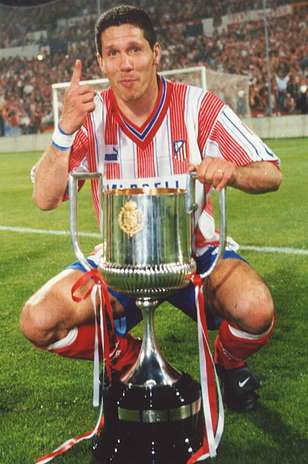
With the Copa del Rey in '96
     In 1994, with another Copa América under his belt, Simeone left Andalucía to join Atlético Madrid, where the club only managed to avoid relegation with a draw on the very last day. The following season saw Luton Town legend Radomir Antić (who incidentally, pop quiz fans, is the only man to have managed Atleti, Real Madrid and Barcelona) installed as the new manager, and he added the likes of goalkeeping mainstay José Francisco Molina and goal-getter extraordinaire Lyuboslav Penev to a squad that already included José Luis Caminero, Juan Vizcaíno and non-jumping tall-man striker Kiko. Cholo drove this talented team onwards, and though Milinko Pantić may have been the playmaker in the side, its main man was Simeone. Los Colchoneros took the league by storm and belied their relegation form of the previous season to end 1996 not only as winners of the Copa del Rey, but also as La Liga champions for the first time since 1977. Quite apart from being the captain and heartbeat of this side, Simeone also scored the winning goal in the game that clinched the league title. Although the following season ended up trophyless for the capital club, Simeone kept his own shiny trinket cabinet topped up by winning an Olympic silver medal as one of three permitted overage players. Atleti's first foray into the Champions League the following season ended with them being knocked out in extra time by Ajax in the quarter-finals.
     Simeone returned to Serie A in 1997 for two seasons with Inter Milan, during which he won the UEFA Cup, and then joined Sven-Göran Eriksson's Argentine revolution at Lazio. A madly talented, free-flowing team in pastel blue that also included Juan Seba Verón, Néstor Sensini and Hernán Crespo won a rare Italian double of league and Coppa Italia in his first season in Rome, as well as the UEFA Supercup and, the following season, the Supercoppa Italia. During this time he also
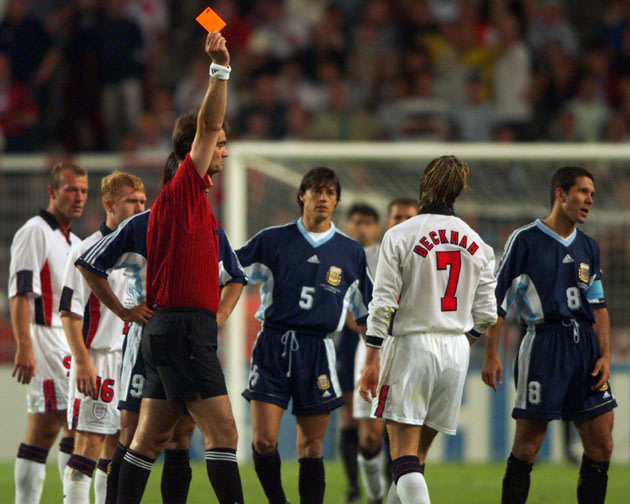
That red card in '98
committed the act for which he is arguably still best known on these shores. The second round game between Argentina and England at World Cup France '98 had been pretty evenly balanced until Cholo, who described his style of play as "holding a knife between my teeth", went down like the proverbial sack of shit after Beckham childishly kicked out at him, managing to persuade busy referee-giraffe hybrid Kim Milton Nielsen to send the future Goldenballs off. It mostly goes forgotten that Simeone also had a big say in the opening goal of the match, bursting through the England defence after 5 minutes and 'making the most' of a slight brush from Seaman to earn Argentina a penalty. He also implored the referee for a card after this. Speaking of Beckham's sending off in 2002, Simeone explained; "I had tackled him, we both fell to the ground. As I was trying to stand up that was when he kicked me from behind. And I took advantage of that. And I think any person would have taken advantage of that in just the same way. Sometimes you get sent off, sometimes you don't. Unfortunately for the English team that time they lost a player. Anyway, you take advantage of all the opportunities you find in your life. If you don't take advantage of a chance that comes your way you are lost."
In his 2nd Atleti spell, here
with Torres (his captain)
     After four seasons in Italy, the battle-hardened Cholo returned to Atlético Madrid in 2003. Since his departure six years before, the team had fallen on hard times. Relegated in 2000, the side was rebuilt by Atleti legend Luis Aragonés with a young Fernando Torres the focal point of the attack, and returned to the Primera in 2002, finishing 11th in their first season back in the bigtime. Cholo did not taste the same success as he had the first time in the red and white stripes, and left in 2005 for one last playing position back in Argentina, with Racing Club.
     Simeone tells the story of how, after his last professional game on February 16, 2006, he spent half an hour in the shower trying to decide whether he really wanted to stay in football and become a manager. At least that's what he says he was doing... Either way, by the time he'd dried himself off, Cholo had decided he would indeed cross the white line and try his hand at this managerial lark.
    He took over the reins at Racing immediately, turning the team's fortunes around in just three months to bring an impressive end to the 2006 Clausura after its dodgy start. In May he left when ownership of the club changed hands and took over at Estudiantes within the month. Cholo led the La Plata club to one of the very few trophies in its history, collecting the 2006 Apertura title after beating Boca Juniors 2-1 in a playoff after the pair finished level on points. By December 2007 he had moved on from Estudiantes to Argentine giants River Plate, succeeding his former international manager Daniel Passarella. Although he remained for less than a full year, he still brought the 2008 Clausura title to los Millonarios. Nevertheless, he eventually handed in his resignation with River bottom of the table after 11 domestic games without a win. It was not until April 2009 that Cholo joined another Primera División team, San Lorenzo, where he would remain for almost exactly a year. He quit in April 2010 following poor results and increasing criticism of his tactics.
     After San Lorenzo, Simeone had some time out of the game before coming back to Europe to take over the reins at Sicily side Catania. The former tough-tackling midfielder was tasked with keeping Gli Elefanti in Serie A, which he achieved despite heavy odds. Mission accomplished at season's end, Cholo returned to Argentina and Racing, staying 'til the end of the year.
Back at Atleti for a third time
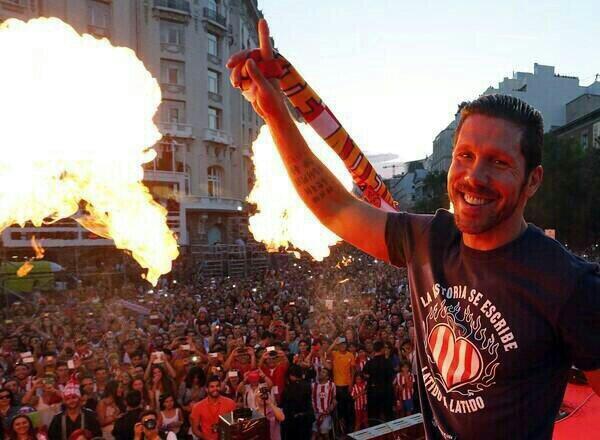
     Just two days before Christmas 2011, on December 23, Diego Simeone returned to Atlético Madrid for a third stint, this time as manager, replacing Gregorio Manzano. The team were languishing just four points off the relegation zone when he came in and were a shambles off the field - mired in debts of over half a billion euros. In order to stave off the creditors, the club had been forced to continually sell its prized playing assets. Just before the new manager's arrival, Atleti had been playing in front of a half-full Vicente Calderón stadium and even lost in the Copa del Rey to third-tier Albacete, and the new gaffer knew he had one hell of a job to rebuild the club as well as the team. But then he always did enjoy a challenge - on the field as well as off it. To begin with he made minor adjustments such as changing the colour of the nets in the goals - from black to match the team's red and white kit. He also began working on the players' mindsets as well as tactics on the training pitch. Cholo's motivational techniques are already public knowledge, and possibly the most well-known of these is his way of giving pre-match individual talks before the players go to bed, rationalising that "just like children, they listen best just before bedtime". I'll be frank; the image of the former bustling midfielder - still so energetic on the sidelines during games - wearing black and hunched over in a little chair next to players' beds reading them bedtime stories from his book of tactics before sleepy time leaves me slightly unnerved. Still, you can't knock the man's results..
     He also began to rework the team in his own image, getting them to play a high-pressing game, aggressively hunting after the ball non-stop and attacking as a unit. He has since explained that "It’s hard for me to interact with players who don’t give themselves completely. The weak don’t interest me." Expanding on the theme, he's stated that competition between teammates is the driving force which keeps his teams steaming forward, saying "There is only one form of motivation, the lifeline of any team: internal competition. If there is no competition between players, the team dies. It’s the only situation which strengthens the coach."
Gio Simeone after going through
a 'hazing' ritual at River
     Although he had always felt sure he'd return to Atlético after leaving in 2005, it took a lot for Simeone to leave Argentina this last time to do so. The offer to manage the club represented a dream to Cholo, but he knew it would mean leaving his family behind in his homeland. He did not want to keep uprooting them with every new job, and a move to Spain would put too much strain on them, he reasoned. Besides that, all three of his sons play at various levels for River Plate - Giovanni had just broken into the first team when los Rojiblancos called on his father to save them. Perhaps if his father had stayed in Argentina, young Gio's teammates would have been too afraid to shave half his hair off when he signed his first professional contract..
     Despite Atleti's poor position when he took over, Simeone's work with the squad yielded immediate results and they went unbeaten in his first seven games in the dugout, only losing 2-1 to Barcelona in the eighth. This was no 'new-manager bounce' however and Atleti continued to climb the table, eventually finishing fifth. The newly-positive team prospered in Europe also, with Cholo leading them to the Europa League final where they beat a young, fluid and highly-fancied Athletic Bilbao side, which had utterly outclassed Manchester United in an earlier round, 3-0.
Celebrating the 4-1 European Super
Cup demolition of Chelsea
     The following season began with a strong statement of intent, los Colchoneros smashing the shit out of a stunned Chelsea 4-1 in the UEFA Super Cup with Radamel Falcao helping himself to a 45 minute hat-trick. Although Simeone's charges drew the first Primera División game of the season 1-1 against Levante, they then won their next eight games on the spin, taking them to second place. They did not fall far off the pace the rest of the season and finished third, thereby qualifying for the Champions League the following year. Although Atleti conceded their Europa League crown in only the round of 32, the fans had much to celebrate come the season's end, having defeated the old enemy Real Madrid in the Copa del Rey final. A brutal game with 15 yellow cards (two becoming reds) required extra time to separate the teams, and gender-bendingly named Miranda eventually settled the game with a header from a corner. Points for originality there. This was Atleti's first victory over la Real going all the way back to 1999 - they had lost the last ten on the bounce - and was all the sweeter for the game being played at the Bernabéu.
Handing over the mantle;
Falcao and Costa
     Atlético Madrid suffered a huge loss at the beginning of the 2013-14 season when Falcao was sold to Monaco for a reported EUR60m. El Tigre had scored 34 goals in 41 games in all competitions and would be nigh-on impossible to replace. Atleti used some of the money to bring in all-time Spain top-scorer David Villa from Barcelona for around EUR5m, but he was 31 and had only scored 10 league goals for Barça the previous season. Instead of splurging more of those Falcao millions up front, Simeone trusted in Diego Costa to find the goals that had been eluding him - he also had 10 league goals to his name the previous season, and just 6 in 2010/11. The Argentine's trust evidently paid off as the big Brazilian Spanish striker stepped out of Falcao's shadow to bang in 35 wage-earners in 44 Primera División and Champions League games this season.
     Atleti's run to win the league and lose in the Champions League final and Copa del Rey semifinal to Real Madrid in 2014 was not based solely upon Diego Costa's goals, though. There's a strong will and team ethic that runs through this team. Simeone used fewer players than any of the other teams around him this season, and seven of the ten players with the most minutes played in La Liga over 2013/14 have been under his charge. Like many other Argentine and South American managers, his tactics mirror those of Marcelo Bielsa; pressuring teams high up the pitch and extremely early, never giving opponents a moment to dwell on the ball. Every win against Cholo's Atleti side has to be earned, they give away neither goals nor games cheaply. At least, not until those last few games of the season. Los Colchoneros did not lose to Real Madrid or Barcelona in the league whatsoever, and beat los Culés over two legs in the Champions League into the bargain. And yet despite a storming start to the league in which they won their first eight games, Atleti still found themselves in second. That's how crazy the level is at the top in Spain. No-one thought they had the staying power to challenge for the entire season; even Cholo said he was taking it "game by game".
Celebrating a successful and amazing season
"Game by game" was his answer every week at the post-match press conferences, "game by game" right to the end. Atlético did not hit the summit of the league until gameweek 22, and even then that was only for one week. The following week they dropped to third. But on matchday 29 they took first place again and were not dislodged until the 33rd minute of that infamous final game against Barcelona at Camp Nou. Of course, as history will relate, they believed in themselves and rallied superbly at the start of the second half to level through a smashing header from Diego Godín - the Uruguayan who was once transferred for less than the price of a pair of football boots but can now call himself a Primera División champion.
     The same player had given his team the lead against  Real Madrid in the Champions League final in Lisbon a week later, but heartbreakingly saw it cancelled out in the 93rd minute by a Sergio Ramos leveller. Los Blancos went on to claim their fabled Décima with a 4-1 victory, but Simeone was proud of his players in defeat, saying they had "given their all". And that's all he ever asks. After the game he said "People say that winning is the most important thing, but the support we've had from people tells you there's another side to it. I told my players that, when you've played as well as they did tonight, to keep their heads up and start thinking about next season. You can lose or you
The man(ager) in black
can win - this time it's our turn to lose and we know we've given it our all. People responded to what the team have done and that allows us to grow further and continue to compete." Nonetheless, he demonstrated his winner-takes-all mindset when describing his feelings about losing the final; "It's not sadness, it's bitterness. I feel bitter that I didn't reach our objective. I wish I could have won the way I wanted, but I couldn't - though I can overcome this. I know that, once you've given your all, there's other players and another match." In the end though, he said "the supporters should be proud of an excellent season, they shouldn't waste a single second being sad. Once you've given your all, you can't go around licking your wounds - you have to come back and compete next season, go around annoying other teams and being pests next year too."
     That was his plan this year - to be a pest to the big clubs. You can bet Atleti - and Cholo - will prove to be more than that next season, even if they do lose Courtois and Costa as expected. Atlético Madrid lost the 1974 European Cup final 4-0 to Bayern Munich in a replay after the first game ended 1-1 with the Bavarians equalising through a 40 yard wonder strike from signature collectors' favourite Hans-Georg Schwarzenbeck in the very last minute of extra time. Since that moment, Atleti were nicknamed El Pupas, or The Jinxed Ones. And since that time they've contrived to repeatedly shoot themselves in the foot and let their fans down in ever-more elaborate ways. Although they did lose the Champions League in that most typical of Atleti fashions this time around, they managed to repeatedly beat the so-called big teams all season and won an astounding and improbable league championship: Cholo has turned the mentality of the entire club around. They're now winners - and they play to win. Just like Cholo.